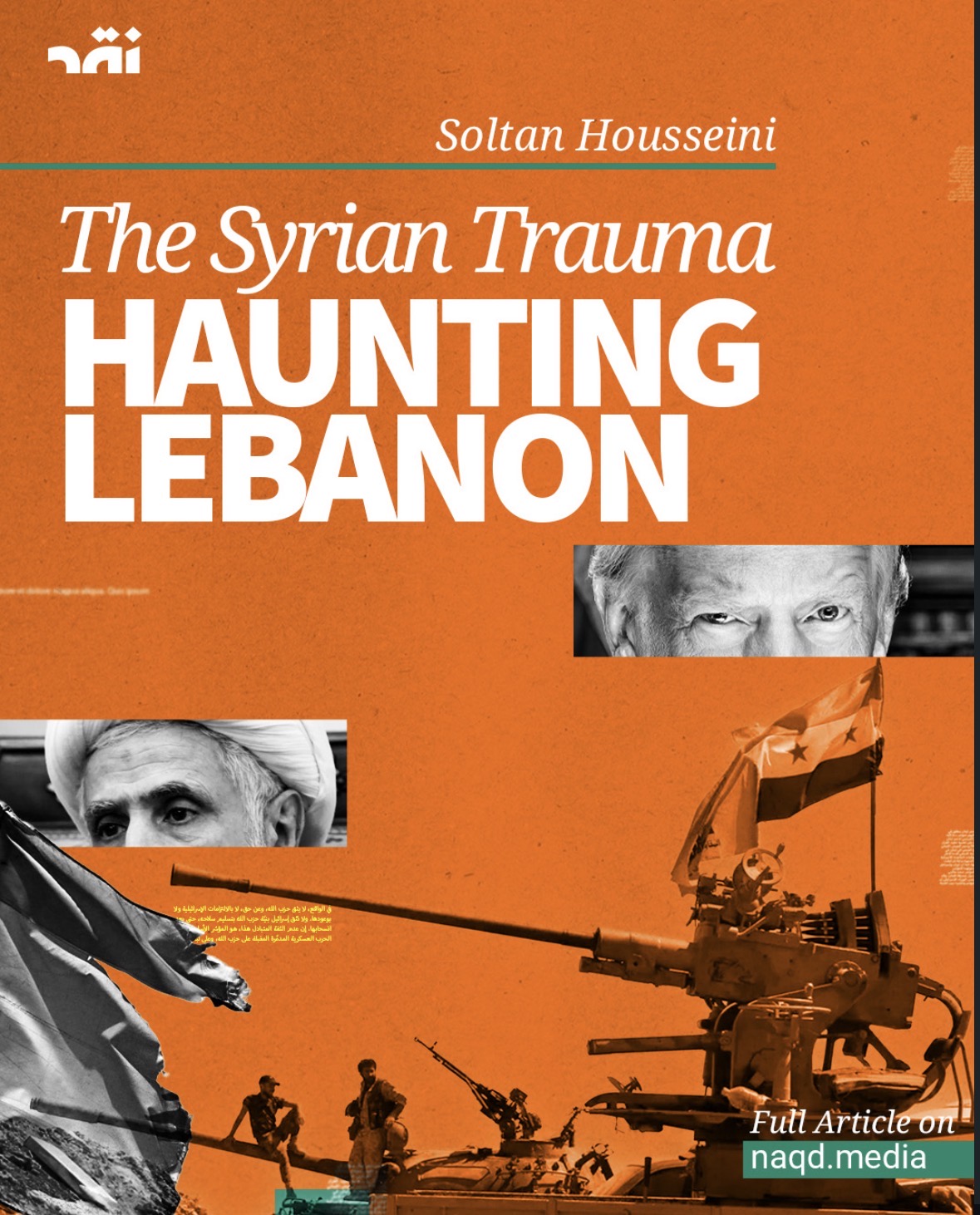

The Syrian intervention in Lebanon constitutes one of the most influential historical experiences in contemporary Lebanese political consciousness. From the entry of Syrian forces into Lebanon in 1976 during the Lebanese Civil War to their withdrawal in 2005 following the assassination of former Prime Minister Rafik Hariri, Lebanese society accumulated a complex political and social experience that can be described as a form of “political and social trauma”; that is, the profound impact that prolonged external domination leaves on the collective memory of both the state and society.
Today, following remarks by U.S. President Donald Trump regarding the possibility that Syria could play a role in facilitating “more precise” strikes against Hezbollah in Lebanon in parallel with the ongoing war, this collective memory has returned to the forefront. It is no longer merely a historical event but also an analytical framework through which Lebanese reactions to any potential return of a Syrian military role in the country, under the new Syrian administration, can be understood.
Do reports of a forthcoming Syrian military operation in Lebanon represent a genuine discussion of possible future developments, or are they merely another manifestation of the “trauma” that Lebanese society continues to experience regarding Syrian intervention in the country?
The Impact of Syrian Intervention in Lebanon Under the Assads Syrian forces entered Lebanon in June 1976 under the banner of the Arab Deterrent Force, which had been approved by the League of Arab States with the aim of ending the Lebanese Civil War. However, political and military realities quickly evolved toward the consolidation of extensive Syrian influence within the Lebanese state. Over time, this presence became a decisive factor in reshaping the country’s political and security balances through both direct and indirect control over key centers of Lebanese decision-making, in what can accurately be described as a form of “security tutelage.”
This influence was further reinforced when Syria was granted a central role in constructing Lebanon’s security and institutional arrangements under the 1989 Taif Agreement. Lebanese citizens experienced a Syrian presence that evolved from a temporary role into an occupation that utilized the Lebanese arena in pursuit of Syria’s regional and international political objectives, often at the expense of Lebanese men and women.
The Syrian intervention was fundamentally rooted in a particular political conception held by the Syrian leadership regarding the nature of relations between the two countries. The political justification for the intervention relied on a discourse centered on protecting Lebanon and preventing its collapse. Yet this discourse was accompanied by a Syrian vision that viewed Lebanon as a small state within a broader regional equation, thereby enabling Damascus to justify both its intervention and its direct influence over Lebanese state affairs.
In the same context, Syrian policy publicly portrayed itself as a mediator seeking settlement and peace. In practice, however, it shifted the center of conflict from Syrian territory to Lebanon. Throughout the various phases of Syrian-Israeli negotiations, Lebanon became an arena through which Syria tightened its grip on the country and leveraged its ability to influence both the framework of Palestinian armed activity in Lebanon and the containment of Hezbollah as bargaining tools vis-à-vis the United States and Israel. The costs of these policies were ultimately borne by the Lebanese people.
The Syrian intervention was not merely a military presence; it left profound marks on the structure of Lebanon’s political system and on the memory of its society. This experience can be understood through the concept of “collective political trauma,” a term used to describe the long-term effects that periods of domination or occupation have on shaping the political identities of societies. The Syrian experience in Lebanon did not simply produce temporary political disagreements; it contributed to the construction of competing and contradictory narratives within Lebanese society. These narratives continued to shape political contestation in Lebanon even after the Syrian withdrawal.
Political Trauma and the Return of Memory During Critical Moments
Studies of collective memory in political science demonstrate that societies that have experienced periods of external domination often revisit those experiences during times of crisis. In other words, current events are interpreted through the lens of political history. In the Lebanese case, any discussion of a possible new Syrian military intervention automatically revives this reservoir of collective memory. For a large segment of Lebanese society, Syria is not viewed merely as a neighboring state but as a political actor associated with a long period of direct influence over Lebanon.
This phenomenon is known in political studies as the “reactivation of historical memory in times of crisis,” whereby the past becomes a framework for understanding the present and anticipating the future. It stems from the fact that collective memory is not simply an archive of events but also a cognitive framework that shapes societal perceptions of risks and opportunities. Sociologists have emphasized that collective memory is constructed within social groups and continuously reshaped according to prevailing political and cultural circumstances, allowing the past to remain an active force in interpreting the present and defining future possibilities.
The Impact of Hezbollah’s Intervention in the Syrian War
The Lebanese case demonstrates that the collective memory associated with Syrian intervention cannot be reduced to a single historical factor or solely to the previous experience of Syrian political and military domination. It is also shaped by an additional factor that has played a decisive role in reproducing and reactivating this memory in public consciousness. This factor is Hezbollah’s intervention in the Syrian conflict since 2013.
This intervention was not merely an isolated military event; it became a central element of political and social debate in both Lebanon and the wider region. It reopened questions surrounding Lebanese-Syrian relations from a different perspective, shifting them from the framework of historical memory associated with the era of Syrian tutelage to a new framework linked to the intersection of regional conflicts and domestic divisions regarding Lebanon’s place within those conflicts.
In this sense, the issue of Syrian intervention is no longer interpreted solely through the lens of the past. It has become connected to a series of contemporary developments that have revived debates over sovereignty and the boundaries separating the Lebanese and Syrian political spheres.
Moreover, Hezbollah’s participation in the fighting inside Syria contributed to deepening sectarian debates within Lebanon. For broad segments of public opinion, this involvement became associated with the renewed politicization of sectarian identities within the context of the Syrian conflict. This, in turn, contributed to the reproduction of longstanding divisions between Lebanese and Syrian societies and generated social and political tensions reflected in media and political discourse in both countries.
From this perspective, it can be argued that the “political trauma” associated with Syrian intervention in Lebanon is no longer solely the product of historical memory. Rather, it has become the outcome of the interaction between two interconnected factors: first, the long historical experience of Syrian intervention in Lebanon; and second, the new dynamics resulting from the involvement of Lebanese actors in the Syrian conflict. The combination of these factors has reinforced a climate of anticipation and skepticism among a large segment of Lebanese public opinion, leading new regional developments to be interpreted through a historical framework that remains deeply embedded in Lebanese political consciousness while simultaneously being assessed through objective and rational considerations linked to regional power dynamics.
Between Political Memory and Strategic Reality
Understanding Lebanese reactions to any potential return of a Syrian military role requires combining two levels of analysis. The first is a historical-psychological level connected to collective memory and the long experience of Syrian intervention. The second is a strategic level related to regional balances of power and ongoing geopolitical transformations in the Middle East.
Politics in Lebanon, perhaps more than in many other countries, is shaped by the intersection of history, identity, and regional alignments. Consequently, any new military development involving Syria is not interpreted merely as a military event but also as a signal that could reopen the complex files of the past.
On this basis, and given the necessity of approaching conflict in a rational manner—particularly amid the ongoing war in Lebanon and broader regional tensions—the Lebanese government bears primary responsibility for activating diplomatic channels with the new Syrian administration in order to assess the seriousness of claims regarding potential Syrian alignment with Trump’s assertions. It must also work to shield Lebanon from further escalation wherever possible, especially after the immense losses the country has endured over the past three years.