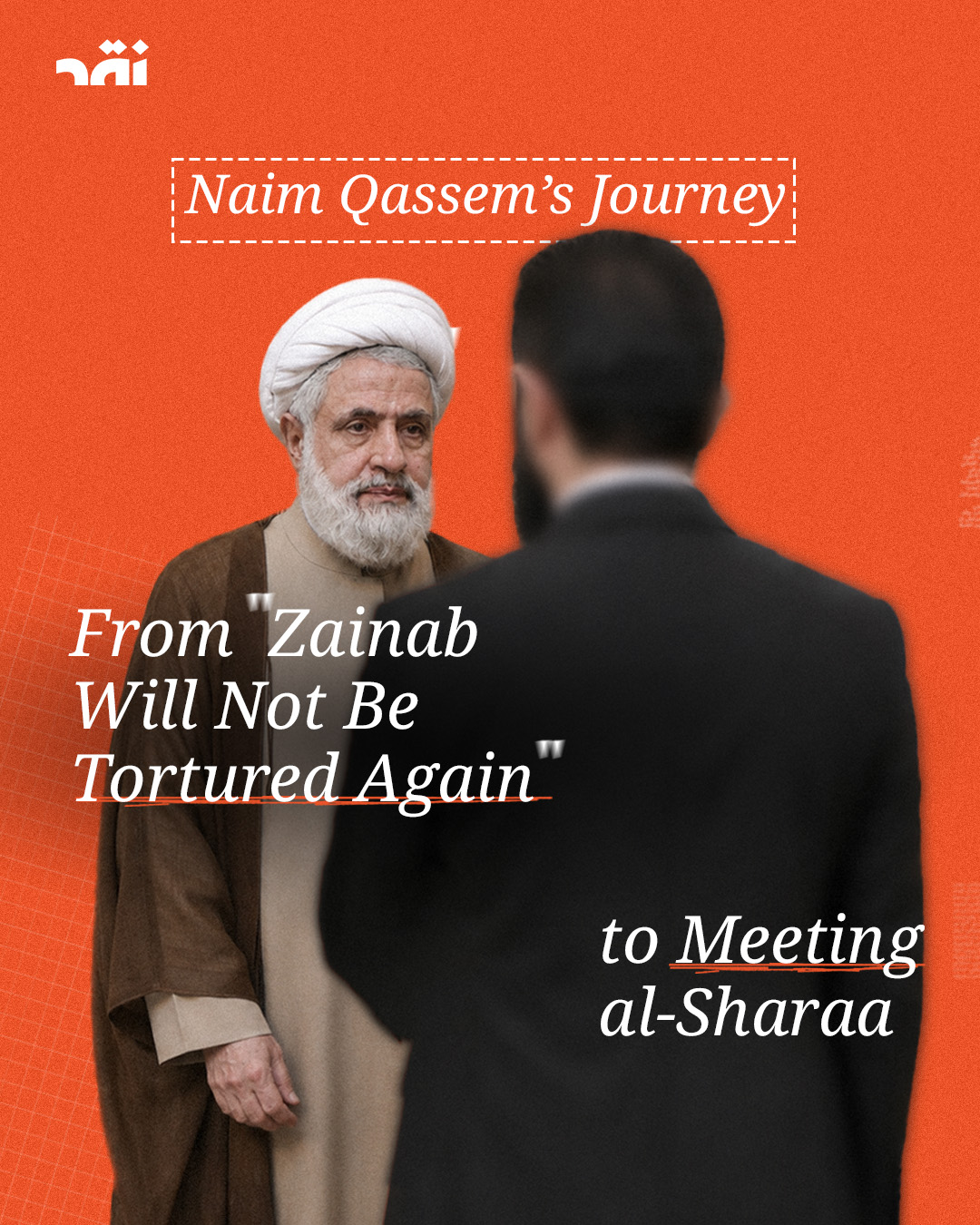

It seems that political U-turns are no longer limited to the mouthpieces of the so-called “Resistance” camp. They have now reached the very top. This was evident in Hezbollah Secretary-General Naim Qassem’s speech yesterday, when he opened the door to engaging with Syria, saying he would not oppose meeting Ahmad al Sharaa.
It is ironic to hear such words from the leader of a group that spent years taking part in the killing of Syrians, backing the Assad regime in its massacres, and justifying its crimes and intervention in the Syrian war under the pretext of fighting “takfiris.” Yet now, after the tables have turned, Hezbollah is willing to sit down with the very same people it once fought and branded as takfiris.
For years, Hezbollah justified its involvement in Syria as a battle to defend religious shrines and confront takfiris, under the slogan, “Zainab will not be tortured twice.” It warned that women would be taken captive and sold in markets, spoke of a “Zionist-American plot” targeting the region, and portrayed defending Bashar al-Assad’s regime as part of that battle.
During those years, Lebanon paid a heavy political, security, and economic price. Its relations with numerous countries deteriorated, while Lebanese society was deeply divided over the decision to drag the country into the Syrian war. Hezbollah continued fighting alongside the Assad regime despite the crimes committed against Syrians and Lebanese, the use of barrel bombs and chemical weapons including sarin gas, and the killing of civilians and children documented before the world.
Today, sitting down with Ahmad al-Sharaa has become an option, after Hezbollah’s involvement in the war contributed to the deaths of thousands of innocent people.
No one knows what the future holds or whether al-Sharaa would agree to sit down with Hezbollah. Either way, Syrians are still waiting for an apology for Hezbollah’s years of fighting alongside the Assad regime, while the Lebanese are still waiting for an apology for dragging Lebanon into a war for which they paid a heavy price.